For teams building with AI

AI prompting gets you an app.
Humans get you a real product.

AI prompting can write code, build screens, and put together a working app in an afternoon. What it can't do, not at the start, not later, is build a product that's safe, compliant, optimised, and ready for real users. That part still needs people. Not just at the end, from the very first line.

The honest picture

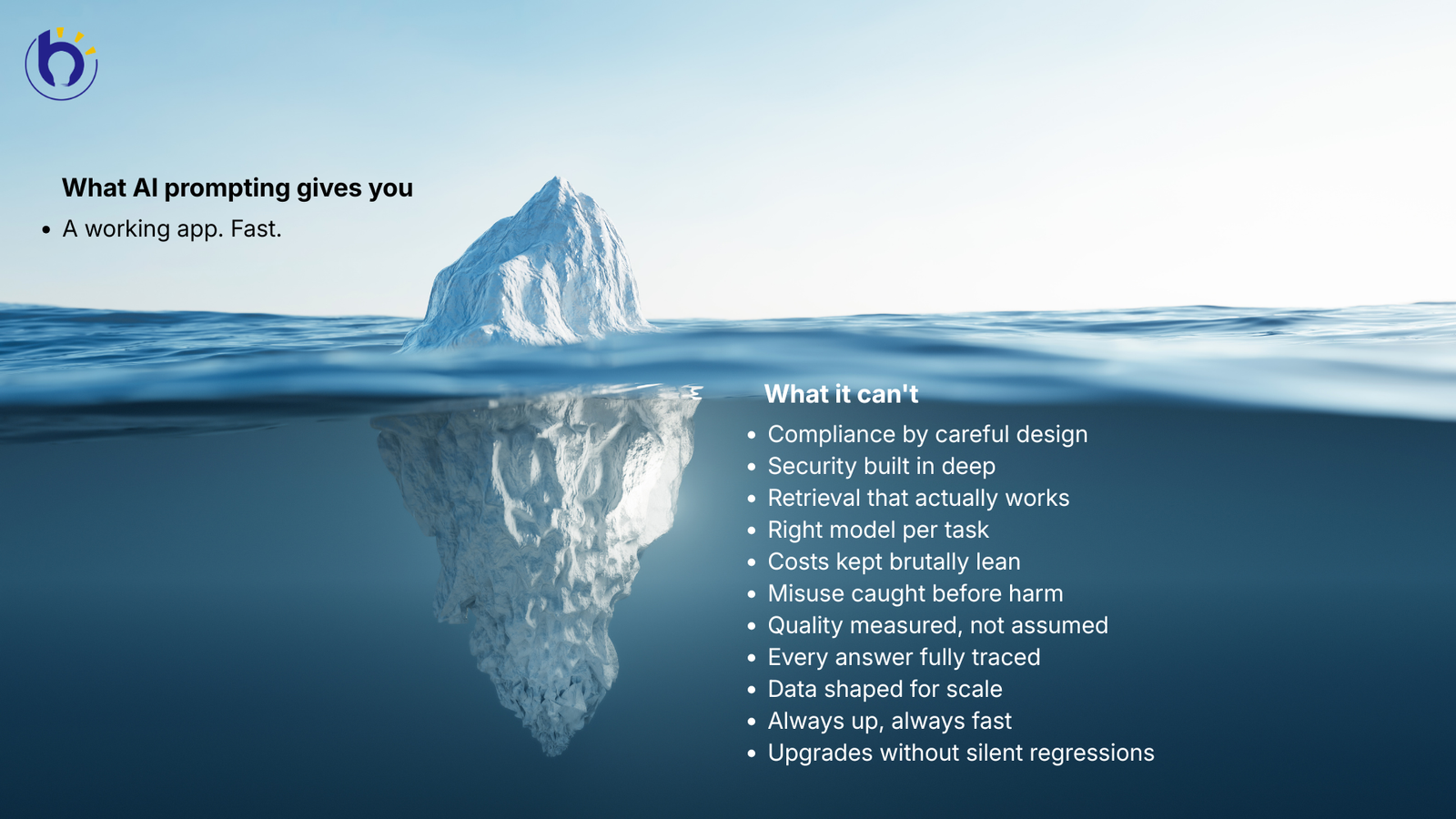
What AI prompting gives you is the tip.

Above the water: an app that runs. Below the water: every decision, every safeguard, every careful choice that turns "it works" into "we can trust it." None of that lives inside a prompt.

Exhibit A: The Iceberg A tip of the iceberg
Above the water: the app. Below the water: everything that makes it a product.
Above the water

A working app

Screens, flows, and code that runs, in hours not weeks.

Above the water

A clean first version

Something you can show, click through, and feel proud of.

Above the water

A fast start

Real progress before the first meeting is over.

This is real. We use AI tooling ourselves every day. It's brilliant at this.

Below the water

What AI prompting can't give you

None of these come from a prompt. They come from people who've shipped real things.

The honest story

You need humans from day one. Not just at the end.

The most common misconception about AI-built apps is that humans only come in later, to "deploy and maintain." That's not how real products work. The hardest decisions, the ones that decide whether your product is safe, fair, fast, and legal, get made on day one. Either by someone who knows what they're doing, or by no one at all.

What AI prompting does brilliantly

It turns an idea into running code, fast

Describe the app, get an app. Screens, logic, a working interface, in a fraction of the time it used to take. For prototyping, for trying ideas, for getting something on screen so you can see if it even feels right, AI prompting is genuinely a step-change. We use it ourselves, every day.

It's brilliant at the visible part. The screens. The flows. The "look, it works." If your goal is to validate an idea or sketch out a feature, AI gets you 80% of the way there before lunch.

But "an app that runs" and "a product real people can trust" are not the same thing. The gap between them is where humans live.

What it can't see, even when it tries

Real products are made of careful choices

How will user data be stored, and for how long? Which model handles which kind of question, and what's the fallback when it fails? How does your RAG system know which document to trust? How do you stop a clever user from making the AI say something embarrassing? What happens to the bill when you go from ten users to ten thousand? Which logs do you keep, which do you delete, and how do you prove it to an auditor?

These aren't questions you ask after launch. They're decisions baked into the very first lines of code, the schema, the model choice, the prompt structure, the auth flow. Get them wrong on day one and you carry that weight forever, or rebuild from scratch. Get them right on day one and the product gets better, cheaper, and safer as it grows.

This is why we say: bring humans in from the beginning. Not to slow you down, to make sure the speed you're getting from AI doesn't quietly cost you everything down the line. And then keep humans around, because models change, regulations change, traffic changes, and someone needs to be there when they do.
How we help

From the first line of code, to the long road after.

We work with you from day one, on the architecture, the compliance, the model choices, all the things AI prompting won't think about for you, and we stay on for the long haul, because real products are never done.

1

Compliance & data architecture

DPDP, GDPR, sector-specific rules, built into the schema and the flows from day one. Audit trails, consent, retention, deletion, the parts your DPO will actually need.

2

Model selection & cost optimisation

The right model for each task, with fallbacks. Caching, batching, prompt compression, routing. We've cut serving costs by 5–10× on real workloads, without dropping quality.

3

RAG & retrieval that works

The right embeddings, the right chunking, the right re-ranker, with eval sets to prove it. Most "RAG" projects fail quietly; ours don't, because we measure them.

4

Security & abuse defence

Auth, role-based access, encryption, secrets management, PII handling. Prompt-injection defence, content filtering, output validation, abuse monitoring, the things your AI app needs that a generic app doesn't.

5

Evaluation & observability

Eval sets, regression tests, scoring rubrics. Logs, traces, dashboards. So you can answer "is the AI doing the right thing?", with data, not vibes.

6

Hosting, scaling & long-term care

Right cloud, right region, autoscaling, monitoring, on-call. Upgrades when models change, patches when CVEs land, eval re-runs when something drifts. We don't disappear after launch.

For your classroom, right now: Bodhaka Theatre is free for every classroom, bring it to your students today.
Let's talk

Tell us what you're building. We'll write back.

You don't need a brief. You don't need a deck. A few honest sentences about what you're trying to build, or where you're stuck, is enough. We read every email ourselves, and we'll get back to you within 24 hours.

Drop us a line

We respond within 24 hours, on working days.

Say hi →

Founders · Product teams · Indie builders · Anyone shipping with AI